FIFA World Cup 1966: A Stolen Trophy, Early Doping Tests and a Set of Dentures
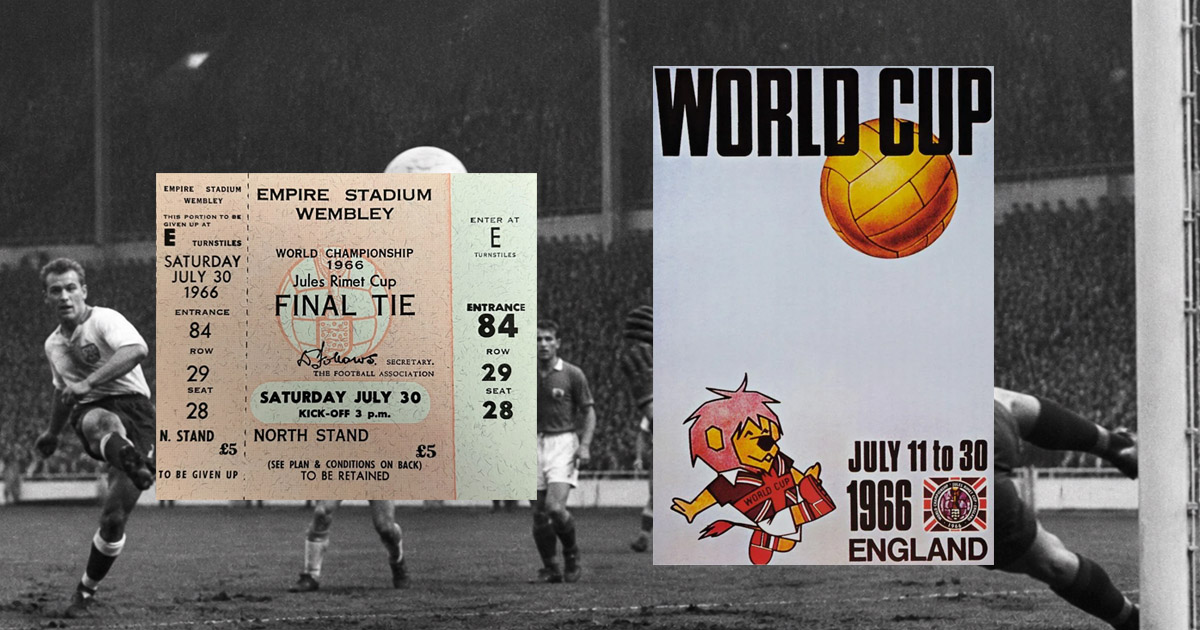
If there is a truly romantic World Cup in the archives, look no further than 1966. Football finally "came home" to England, but not before the host nation managed to misplace the trophy itself.
The tournament was a whirlwind of drama: from the sensational failure of Pelé’s Brazil to the birth of the "Mr. Zwei-Drei" moniker. It even prompted Nikita Khrushchev’s classic barb to the Soviet team: "Who finished fourth in the last World Cup? Don’t remember? That’s exactly how people will remember you." The story begins with a heist, followed by four more extraordinary tales from the summer of '66.
1. An English tea break and a missing masterpiece
The theft of the Jules Rimet Trophy three months before kick-off remains one of football's most surreal chapters. The game's ultimate prize was simply carried out of an exhibition hall.
The trophy, crafted by Abel Lafleur from gold-plated silver, was the centrepiece of the Stampex philatelic exhibition at Westminster Central Hall. FIFA President Stanley Rous had sanctioned the display, reasoning that if stamps worth £3 million were safe, a £3,000 cup (insured for £30,000) would be fine under the same guard.
That guard consisted of six men. On Sunday, March 20, the British devotion to a tea break proved to be their undoing. A thief slipped in through a rear door and removed the padlock from the display case, ignoring the stamps entirely. The culprit, 46-year-old car dealer Edward Betchley, was eventually caught after demanding a £15,000 ransom, claiming he was merely a middleman for a mysterious figure known as "The Pole."
The original, meanwhile, was found in a suburban hedge in Upper Norwood by a dog named Pickles. While the police struggled, Pickles sniffed out the trophy wrapped in old newspaper during a walk with his owner, David Corbett. Realising the trophy was "too hot to handle," the thief had simply ditched it. This embarrassment led FIFA to keep the original trophy under lock and key, using replicas for all future public tours.
2. Football diplomacy: The North Korean headache
The debut of North Korea (DPRK) presented a diplomatic nightmare for the British Foreign Office, as the UK did not officially recognise the state. Diplomats scrambled to ban the North Korean flag and anthem, but with the flagpoles already erected at Ayresome Park, they were reduced to hoping for a swift Korean exit.
Reality soon intervened in Middlesbrough. The locals, largely indifferent to Cold War posturing, fell in love with the underdogs. North Korea played in bright red—the same colours as Middlesbrough FC. Mayor Jack Boothby even declared: "You wear our colours, and we will support you as our own." The town erupted when the Koreans pulled off a stunning 1-0 upset over Italy to reach the quarter-finals.
3. The Birth of Doping Controls
In 1966, anti-doping measures were in their infancy. FIFA introduced mandatory testing for the first time, but it was largely viewed as a formality. However, in 2011, a study revealed that samples from three West German players following the final contained traces of ephedrine.
A scandal never erupted for two reasons: ephedrine was a common ingredient in nasal sprays (and the German squad was battling colds in the damp English climate), and FIFA had not yet established clear threshold limits. The findings were largely dismissed as "therapeutic use," a quiet footnote in a legendary final.
4. 'Night in Sheffield' – A lesson in discipline
Switzerland arrived in England as outsiders, but their campaign imploded due to the "Night in Sheffield." On the eve of their opener against West Germany, star players Jakob Kuhn and Léo Schneiter went out to sample the local nightlife.
The police, having failed to guard the World Cup in London, were remarkably vigilant in Sheffield and detained the pair. Coach Froling promptly suspended them. Switzerland lost 5-0, and Kuhn later said he "died as a player that night." Ironically, Kuhn went on to become Switzerland’s most successful manager 35 years later, building his philosophy on absolute discipline and personally checking players' rooms at night.
5. The anthropology of the foul: From toothless Stiles to Khurtsilava’s nightmare
The Soviet Union achieved their greatest-ever finish in 1966, taking fourth place. They might have taken bronze if not for a bizarre premonition. Defender Murtaz Khurtsilava reportedly dreamed of conceding a penalty against Portugal by reflexively punching a ball meant for the towering José Torres. During the actual match, in the 12th minute, Khurtsilava lived out his nightmare, inexplicably handling the ball in the box and handing Eusébio an easy penalty.
Meanwhile, Nobby Stiles became the personification of the era’s "hard man" style. Partially sighted without his glasses and completely toothless, Stiles would hand his dentures to trainer Benny Callaghan in a special tin before kick-off. When Portugal’s Simões tried to intimidate him by threatening to "knock his teeth out," Nobby simply grinned, showing his bare gums, and informed his rival that his teeth were safely tucked away in the dressing room.
On this day in 1966... 🏴🏆#FIFAWorldCup pic.twitter.com/0p5CBI0w5k
— FIFA World Cup (@FIFAWorldCup) July 30, 2025
Finally, the dismissal of Argentina’s Antonio Rattín against England changed the game forever. Sent off for "violence of the tongue" (despite the German referee not speaking Spanish), Rattín refused to leave for 10 minutes, claiming he needed a translator. Ken Aston, watching from the stands, realised that a visual language was needed to bridge the gap. His inspiration? The red and yellow of traffic lights. The red and yellow card system was born.
England remains the 1966 champion—the only major international trophy the "Home of Football" has ever claimed. For a deeper dive into the stats and brackets, visit our dedicated 1966 World Cup section. Next stop: 1970, and the crowning of the first three-time world champion.
More from our World Cup History series:
- Two match balls and a 15-yard penalty: How the FIFA World Cup story began
- The Oriundi Phenomenon and Athenian Diplomacy: Five paradoxical tales from the 1934 FIFA World Cup
- 1938: When football collided with history
- 1950: National Mourning and the Loudest Silence in Football History
- 1954: The tactical laboratory that reshaped football
- 1958: The birth of a King and the 4-2-4 revolution: Five stories from FIFA World Cup 1958
- 1962: The Most Unsettling World Cup in Football History
- 1966: A Stolen Trophy, Early Doping Tests and a Set of Dentures

