1970 World Cup: The Pelé Pact, a Captain Under Arrest, and the Supercomputer’s First Blunder
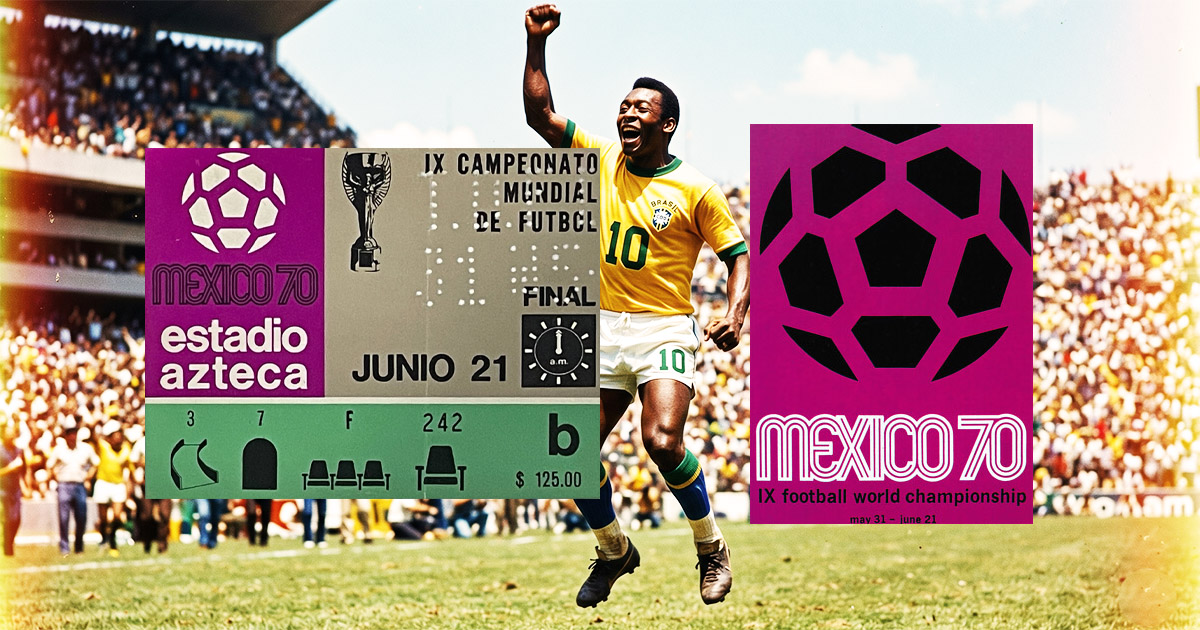
The 1970 World Cup served as a fitting curtain-closer to a golden era of football history. By securing their third title, Brazil met FIFA’s criteria to keep the Jules Rimet Trophy in perpetuity. It was the tournament that cemented Pelé’s legacy as the "King of Football," establishing a record for World Cup winner's medals that remains untouched to this day.
Yet, in Mexico, Pelé’s name was synonymous with more than just on-pitch wizardry.
1. The Pelé Pact: The Million-Dollar Laces
Mexico '70 saw the debut of the Adidas Telstar, the first of the brand’s iconic tournament balls. However, off the pitch, a far more clandestine game was being played by the Dassler brothers, Adi (Adidas) and Rudolf (Puma).
The siblings had entered into a secret "Pelé Pact," agreeing that neither company would approach the Brazilian superstar. It was an attempt to keep player wage demands from skyrocketing. Puma, however, broke rank. They offered Pelé $120,000 (roughly $1 million in today’s money) to take the field in their boots.
The "activation" was pure theatre. Before the quarter-final kick-off against Peru, Pelé requested a moment from the referee to tie his laces in the centre circle. Puma had even bribed the cameraman to ensure a lingering close-up. As millions watched, the Puma logo was beamed into living rooms worldwide — arguably sport’s first truly "viral" marketing stunt.
2. The Prisoner of Bogotá
England’s title defence was thrown into disarray before a ball was even kicked. Captain Bobby Moore was arrested in Bogotá, Colombia, accused of stealing a £600 emerald bracelet from the "Fuego Verde" jewellery shop.
A witness, Clara Padilla, claimed Moore had pocketed the item in his blazer. The accusation bordered on the farcical; during the investigation, it was revealed that Moore’s blazer didn't even have a left pocket. Fearing a diplomatic incident, Colombian authorities placed him under house arrest at the home of Alfonso Senior, President of the Colombian Football Federation.
It remains the most bizarre pre-tournament camp in history: the England captain kept match-fit by jogging around a private garden under the watchful eye of armed soldiers and DAS secret agents. Cleared of all charges due to a total lack of evidence, Moore finally joined the squad in Mexico just three days before their opener against Romania.
💪 The most famous tackle in #WorldCup history?
— FIFA World Cup (@FIFAWorldCup) June 17, 2020
🏴 Fifty years on from 1970, we still haven't forgotten that crucial interception from @England's Bobby Moore #WorldCupAtHome | #Mexico70 pic.twitter.com/0UBjl3ecpq
3. When the Supercomputer Crashed
While modern fans can run complex xG models on their laptops, in 1970, football analytics required serious hardware. A consortium of Mexican broadcasters and France Football leased one of the era’s most powerful mainframes to predict the tournament’s outcome.
The computer was fed data from 172 qualifying matches, player vitals (height, weight, and seasonal minutes), and even local climate data. It successfully predicted 15 out of 28 group stage results, but the knockout rounds proved its undoing.
The computer predicted an England victory over West Germany in a 2-1 final. As for the eventual champions, Brazil? The "Supercomputer" calculated they would not even finish in the top three, finishing a lowly fourth.
4. Medical Panic and "Montezuma’s Revenge
The Mexican heat has always been a logistical nightmare. While 1986 saw the introduction of tactical water breaks, the 1970 solutions were more eccentric.
Dr. Helmut Kaiser of FIFA's medical committee expressed genuine concern that balding European players might suffer severe sunstroke. He suggested that stars like Bobby Charlton and Uwe Seeler wear lightweight hairpieces or porous foam pads to create an "air cushion" over their scalps.
A more tangible threat was "Montezuma’s Revenge" — acute gastric distress caused by local bacteria. England were hit hardest. On the eve of their quarter-final against West Germany, legendary goalkeeper Gordon Banks fell ill. To this day, many in England still believe the Hilton Guadalajara’s kitchen was the site of a deliberate poisoning plot.
5. Charlton’s Smoke and Müller’s "Cursed" Number
In 1970, the era of the "ultra-professional" athlete had yet to arrive. After being substituted during the collapse against West Germany, a dejected Bobby Charlton sat on the bench, chain-smoking cigarettes as he watched England’s lead evaporate.
#OnThisDay in 1970, West Germany got extra time revenge in #WorldCup quarter-final against holders @England pic.twitter.com/khEq0Hf2tn
— FIFA World Cup (@FIFAWorldCup) June 14, 2016
Equally notable was Gerd Müller’s defiance of superstition. In German culture, 13 is considered an omen of ill-fortune. With no one else willing to touch the jersey, "Der Bomber" claimed it for himself. He finished the tournament as the Golden Boot winner with 10 goals, proving that for some, logic trumps luck.
Regardless of the result, the 1970 World Cup final was always destined to be the last in which the winners would receive the iconic Jules Rimet Trophy. At that point, both Brazil and Italy were already two-time world champions, with permanent ownership of the famous statuette reserved for the first nation to claim a third title.
The outcome is well known today, but to relive the full journey of both sides, visit our special page dedicated to the 1970 World Cup.
Next up in the series: the 1974 World Cup — featuring the only-ever West Germany vs East Germany derby, the rise of Rinus Michels and Johan Cruyff’s Total Football, and several other fascinating stories that shaped one of the most influential tournaments in football history.
More from our World Cup History series:
- Two match balls and a 15-yard penalty: How the FIFA World Cup story began
- The Oriundi Phenomenon and Athenian Diplomacy: Five paradoxical tales from the 1934 FIFA World Cup
- 1938: When football collided with history
- 1950: National Mourning and the Loudest Silence in Football History
- 1954: The tactical laboratory that reshaped football
- 1958: The birth of a King and the 4-2-4 revolution: Five stories from FIFA World Cup 1958
- 1962: The Most Unsettling World Cup in Football History
- 1966: A Stolen Trophy, Early Doping Tests and a Set of Dentures
- 1970 World Cup: The Pelé Pact, a Captain Under Arrest, and the Supercomputer’s First Blunder

